During the past week I revisited Forest Acoustics, focusing on the acoustics and sound propagation in such an environment. My aim was to investigate the effect a forest has on sound waves.
Noise Reduction in Forests
It has been noticed that trees and other vegetation are capable of significantly reducing urban noise. A study investigating how vegetation can reduce noise caused by a train, showed that 50 m of forest can result into an extra 8-9 dB noise reduction when compared to a grass-covered country [1]. The absorption of a surface can be determined using the absorption coefficient, which varies between different materials and textures. In a forest, three main categories of surfaces have an effect on the absorption and reflection of sound:
- Tree trunks
- Brunches and foliage
- The forest floor
Sound Absorption in a Forest
When considering a tree on its own, its trunk appears to be the most neutral surfaces as it has a very low absorption coefficient which results into maximum reflection of sound. While brunches behave in a similar way, they tend to be covered by leaves and other vegetation; therefore, the two can be considered as a single medium. Leaves and foliage absorb high frequencies, usually greater than 2kHz [1], and sometimes slightly amplify middle ones. The range of frequencies being absorbed increases with the size of the leaves.
Trees and bushes tend to have a very small absorption coefficient, but noise in forests significantly attenuates. This is mainly because of the forest floor, which has greater noise reduction capabilities, and absorbs some of the lower and middle frequencies [2]. Reethof in 1977 used a Standing-Wave Tube to measure the absorption coefficients of different trees and of the forest’s ground at different frequencies [3]. As part of his study he examined how the texture of the ground affects the absorption of the ground. The results show that the absorption increases with moisture, roughness and vegetation covering the floor.
Conclusion
Overall, while the surfaces in forest tend to have small absorption coefficients, multiple reflections and sound scattering taking place by the tree trunks causes sound do diffuse and attenuate. Next, I will be investigating the scattering of sound in a forest together with Morse book “Vibration and Sound” [4], which studies the scattering of sound in the surface cylinder.
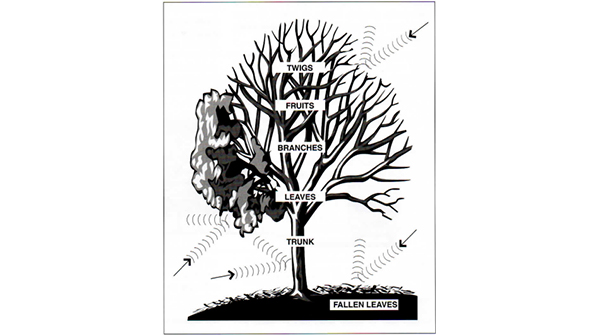
Figure: Sound reflections in different parts of a tree taken by Dobson [2]
[1] Bullen, R., and F. Fricke. 1982. “Sound Propagation through Vegetation.” Journal of Sound and Vibration 80 (1): 11–23.
[2] Dobson, Martin, and Jo Ryan. 2000. Trees and Shrubs for Noise Control. Arboricultural Advisory & Information Service.
[3] Reethof, G., O. H. McDaniel, and G. M. Heisler. 1977. “Sound Absorption Characteristics of Tree Bark and Forest Floor.” In In: Heisler, Gordon M.; Herrington, Lee P., Eds. Proceedings of the Conference on Metropolitan Physical Environment; Gen. Tech. Rep. NE-25. Upper Darby, PA: US Department of Agriculture, Forest Service, Northeastern Forest Experiment Station. 206-217. Vol. 25. https://www.fs.usda.gov/treesearch/pubs/11547.
[4] Morse, Philip Mccord, Acoustical Society of America, and American Institute of Physics. 1948. Vibration and Sound. Vol. 2. McGraw-Hill New York.
 George Sarantinos