During last week I conducted the measurements inside the anechoic chamber of the AudioLab of the University of York. The measurements started on Thursday the 18th and ended on Thursday the 25th of July 2019. With the help of Andrew Chadwick, the tree trunk was screwed on two wooden planks in order to be stabilised, allowing it to stand vertically. He also built the rotating mechanism that would hold the microphone for the measurements and placed the tree on top of it in the centre of the anechoic chamber. The loudspeaker was then placed in the appropriate position, all distances were measured and the angles of rotation were found and marked with the help of lazer pointers. Using a Fireface interface, the equipment were connected to Cubase 5.2 which was responsible for playing back and recording the sine sweeps. The experimental procedure was ready be carried out.
For each measurement session, 3 sine sweeps were recorded for each receiving position, and 12 receiving positions were obtained from each side of the trunk ranging from 180 to 15 degrees, split in 15-degree-intervals. The measurements were repeated for 4 different sides of the trunk by rotating it by 90 degrees each time. After completing each measurement session, MATLAB was used to split each individual sine sweep, deconvolve it into an impulse response (IR) and save it under the appropriate name. The IRs obtained underwent some basic time domain analysis by plotting and comparing their graphs.
The measurements were repeated and analysed multiple times each time improving the set up in an attempt to eliminate unwanted reflections detected in the plots. The final measurements were conducted on Thursday the 25th of July.
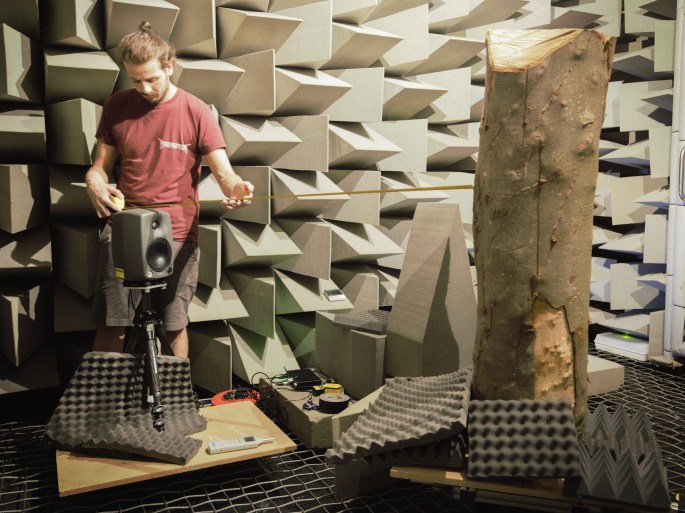
Figure: Preparing the setup for the measurements inside the anechoic chamber
 George Sarantinos