I was assigned by Steficon to do the sound design for a short documentary about ANIMA – Wildlife Conservation Society. ANIMA is an NGO with one of its main objectives being the nursing and rehabilitation of wild animals in their natural habitat. During the lock-down in Athens birds and other animals had to be freed into their natural habitat. Chris Sakellariou was responsible for recording the live sound on site during the shooting of the documentary. I was assigned the post production after being given the final cut. This documentary can be found on ANIMA’s official Youtube channel.
Blog
New Gear and Guitar Cover for my Instagram Profile
After multiple months without a Cabinet for my Randall RX120D Guitar Amplifier it was time for me to upgrade my studio. Due to excess noise and limited room at my house I decided to purchase the Two Notes Torpedo Captor LoadBox. This gear allows me to remove the high voltage signal coming out of the output of the amplifier and safely connecting to the my Audio Device. It also comes with 2 built in Cab IRs and real time convolution. I put the new product to the test by recording, mixing and mastering another cover by one of my favorite bands Oathbreaker. For this song I tried to produce a more Atmospheric Black Metal Sound. A video of Needles in Your Skin by Oathbreaker was then uploaded on my Instagram profile.
Guitar Cover – Emperor
While searching and applying for different jobs in Greece, the UK and other European countries, I continued to play the guitar and to produce music. Lately, I’ve been experimenting with a free drum machine and other VST instruments such as synthesizers and virtual Choir. In order to put everything to the test, I decided to fully record and produce another guitar cover by one of my favorite bands Emperor. My aim was to make the keys cut through the mix and coexist with the guitars without sounding muddy. A video of the song Inno A Satana by Emperor was then uploaded to my Instagram profile.
MSc Graduation – University of York
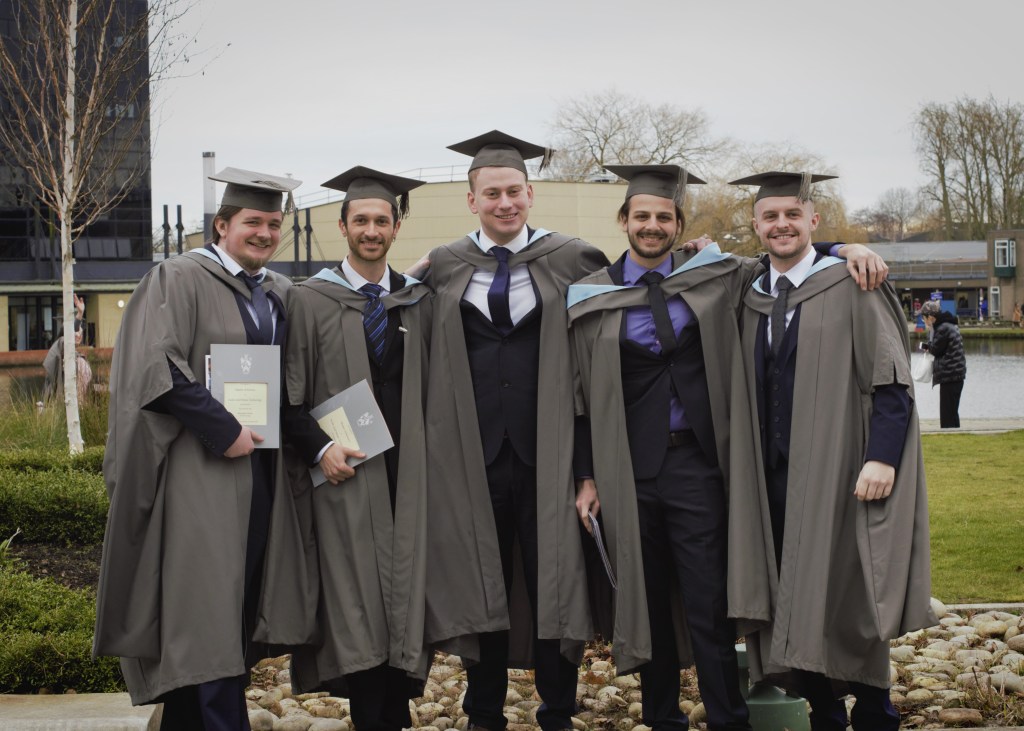
I attended my graduation ceremony on the 25th of January 2020 to receive my Degree. I graduated with a Distinction on my MSc in Audio and Music Technology from the University of York. It was a wonderful weekend were I revisited the beautiful city of York in which I had spent 4 of the best years of my life, reconnected with friends, course-mates as well as some of my professors. It was wonderful to see how everyone was making their first steps into the real world after finishing university.
Guitar Cover – Deathspell Omega
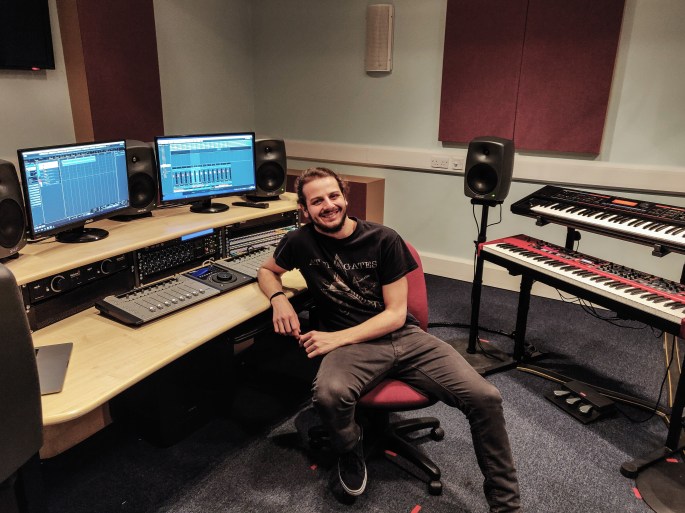
For several months I had to stay away from music production, initially, in order to concentrate on my Master’s thesis, then, during fall, to focus on my personal and professonal development in the audio industry. When I was finally given the time I learned and performed Apokatastasis Panton by Deathspell Omega and the video was uploaded on my Instagram profile.
Taking a Python Course in Udemy
During my masters degree at the University of York, I used MATLAB throughout the year to perform audio processing as well as work with IRs and their analysis. Upon my return in my homeland Athens, Greece, I decided to familiarise with Python which is a free, open-source programming language known to be very powerful. I started taking an online course in Udemy called “Complete Python Bootcamp From Zero to Hero in Python”. My aim is to familiarise with python and slowly start to experiment with audio processing. In the future I would be interested in finding out more about machine learning with Python.

University Final Grade: Distinction
Today we received our final marks and feedback on our End of Year Research Projects. I am proud to announce that I will be graduating with a Distinction in my MSc in Audio and Music Technology from the University of York. I would like to especially thank my Project Supervisors Dr. Frank Stevens and Dr. Jude Brereton for their help and support throughout, as well as Andrew Chadwick for helping me plan and run the experimental procedure. Furthermore, I would like to thank my course-mates and close friends for their support and good company, as well as all the teaching staff in my department.
Final Analysis and Conclusion
The final report was submitted on Wednesday the 4th of September early in the morning, just a few hours before the deadline. The report was written using LaTex and can be found on My Projects. Overall the project was successful by covering all the desired topics as well as leaving plenty of room for future work.
Both experimental procedures were conducted to a high degree of accuracy, resulting on clear noticeable patterns on the measured IRs. Time nad Frequency Domain analysis was contacted for all the IRs which were also edited appropriately to extract and remove the peak of the direct sound. The Reflected peaks were also compared to the theoretical IRs obtained from Morse’s calculations. The spectrums of the two were compared and can be found on the Figure below.
This project showed that there is some correlation between the experimental and theoretical IRs, suggesting that the sound scatters from the surface of a tree in a similar way to that of a perfectly reflective cylinder. The rounder the trunk, the more similar the spectrum were. Considering that a certain amount of absorption must also be taking place by the surface of the tree, the calculated IRs could be also processed by implementing the effect of the absorption coefficient of a tree. This should make the two spectrums look more similar.
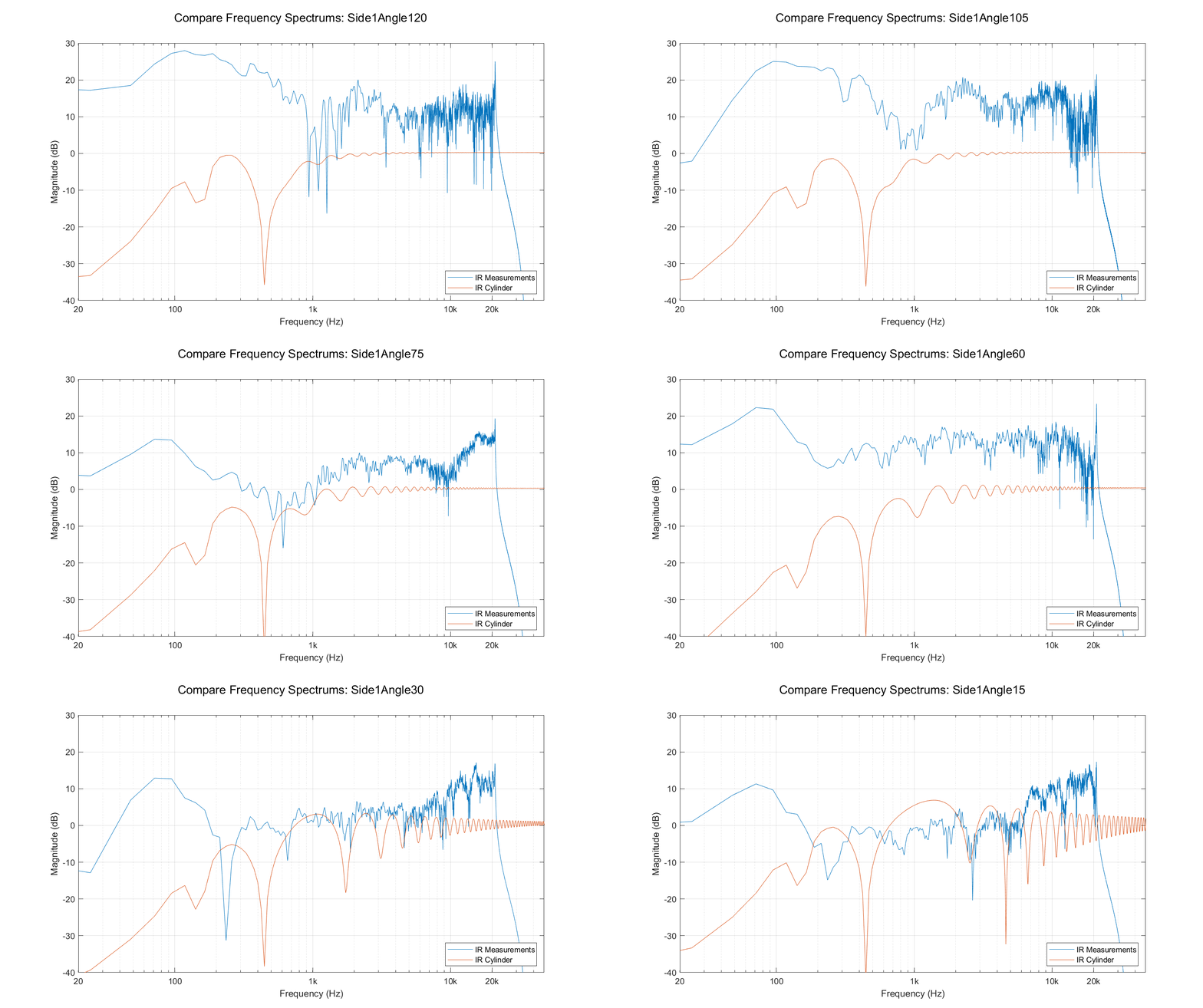
Figure: The frequency spectrum of the Theoretical and Experimental IRs
Repeating the Measurements
The IRs have been edited and analysed for a long time after the measurements in an attempt to understand and eliminate the additional peaks. However, these peaks were affecting the frequency spectrum significantly, making the experiment inaccurate when comparing them to the theoretical IRs. As a result the experimental procedure had to be repeated.
The anechoic chamber was booked for 2 consecutive days on Monday the 19th and Tuesday the 20th of August. Even though this was only two weeks away from the deadline of the project, it was the only time available. To save time, the required MATLAB scripts were created in advance using the IRs from the previous measurements. This would speed up significantly their analysis stage.
The experimental procedure was repeated. After setting everything up just like last time, the measurements took place for a single side of a the trunk and then analysed. The same unwanted peak was still present in the IRs. This suggested that there was an unwanted reflection within the system. After examining multiple potential surfaces, using trigonometry, and by repeating measurements. It appeared that the reflection was most likely caused by the net on the floor of the chamber. The measurements were repeated after placing foam on the floor. The unwanted peak was significantly eliminated. The measurements were repeated once again from the beginning.
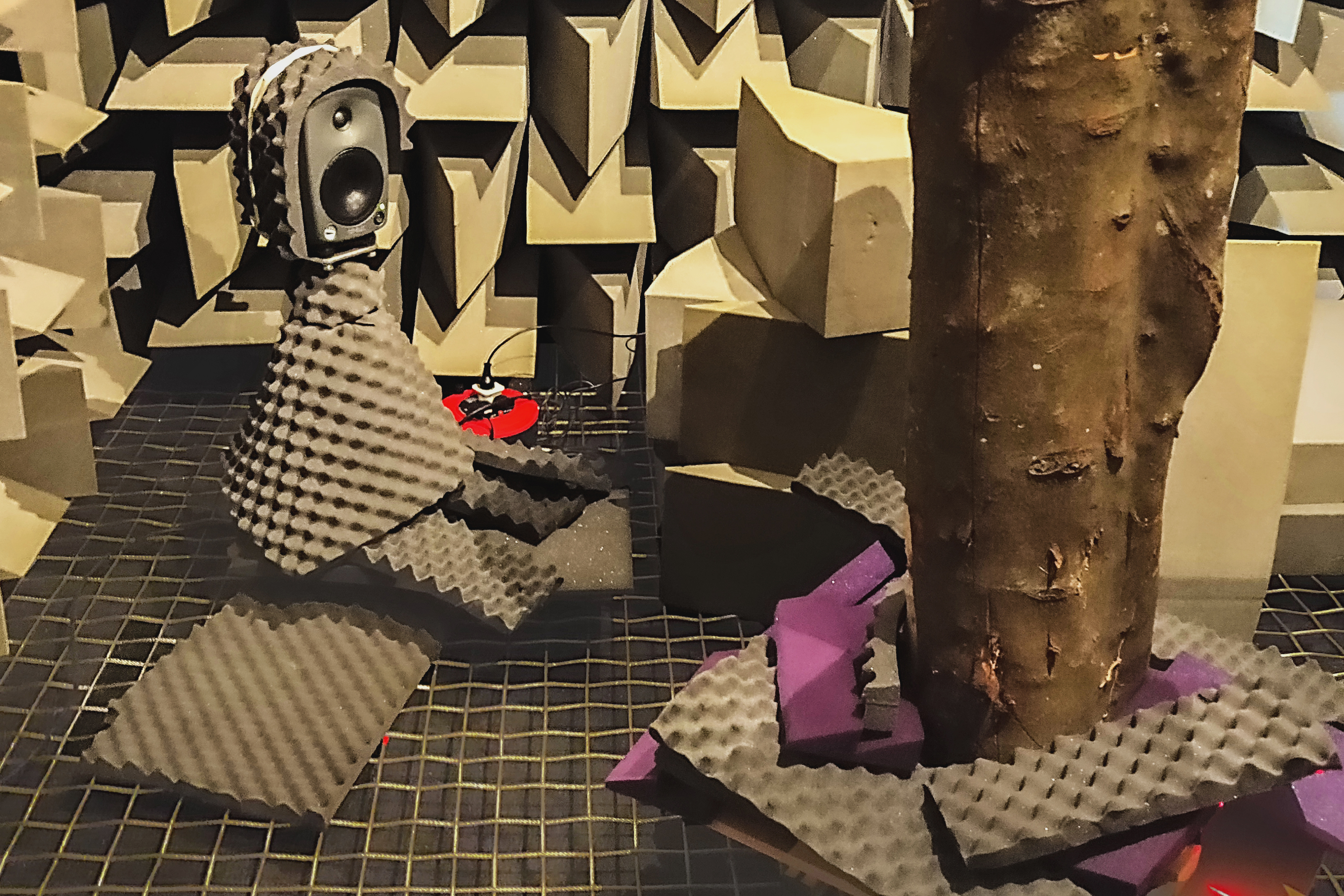
Figure: Place foam on the floor of the Anechoic Chamber to eliminate the unwanted reflections in small angles.
Unwanted Reflections Detected
After the experimental procedure was completed on Thursday the 25th of July, the anechoic chamber was emptied as it was booked by other parties to conduct different measurements. In the meantime, the project entered the analysis stage. Before isolating and examining the reflected peak I created a MATLAB script responsible for importing all the Impulse Responses (IR) obtained from the experimental procedure, storing them into structures and plotting them in the time domain.
When analysing the plots, the IRs seemed consistent. As expected, the different takes obtained from the same angles appeared to be almost identical following consistent patterns as the microphone moved around the trunk. Unfortunately, even though the measurements were obtained with much care at a high degree of accuracy, the graphs of the IRs of the smaller angles, were the microphone was the closest to the loudspeaker presented 3 peaks, suggesting that there was an unwanted reflection. After studying carefully the setup, two potential causes were considered:
- There was feedback on the microphone
- There was an unwanted reflection due to an exposed hard surface
Since the anechoic chamber is currently unavailable the measurements can not be repeated. As a result, the next weeks will be used to see whether this unwanted peak can be ignored or even eliminated by editing the IRs on MATLAB.
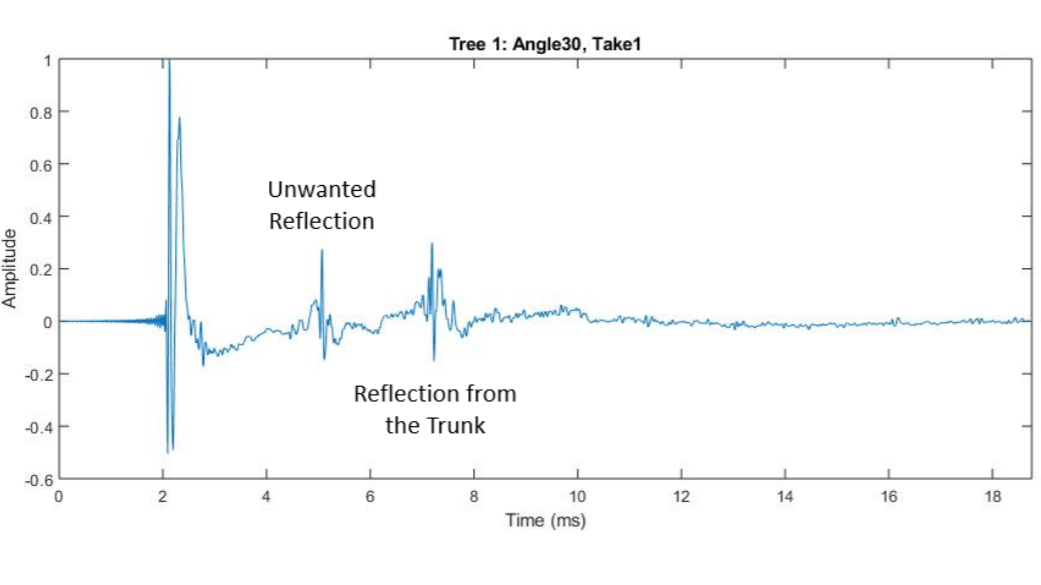
Figure: Plot of the IR showing the unwanted peak and the reflection from the trunk
 George Sarantinos